

Activated Carbon Dosage Calculation: How to Size GAC and PAC for Water Treatment
发布时间:
2026-08-06
作者:
卡尔活性炭
来源:
卡尔活性炭
摘要
Activated Carbon Dosage Calculation: How to Size GAC and PAC for Water Treatment
 |
An accurate activated carbon dosage calculation helps a water treatment system achieve its removal target without oversizing the equipment or consuming more carbon than necessary.
However, there is no universal activated carbon dose that applies to every project. The required quantity depends on the form of activated carbon, the contaminant being treated, the water flow rate, influent concentration, treatment objective, contact time, water chemistry, and the adsorption performance of the selected carbon.
The first step is to distinguish between granular activated carbon and powdered activated carbon:
Granular activated carbon, or GAC, is normally installed in a fixed-bed adsorber. The calculation focuses on bed volume, empty bed contact time, carbon mass, carbon usage rate, and replacement frequency.
Powdered activated carbon, or PAC, is added directly to water. The calculation focuses on the dose in mg/L and the daily or hourly carbon consumption in kg.
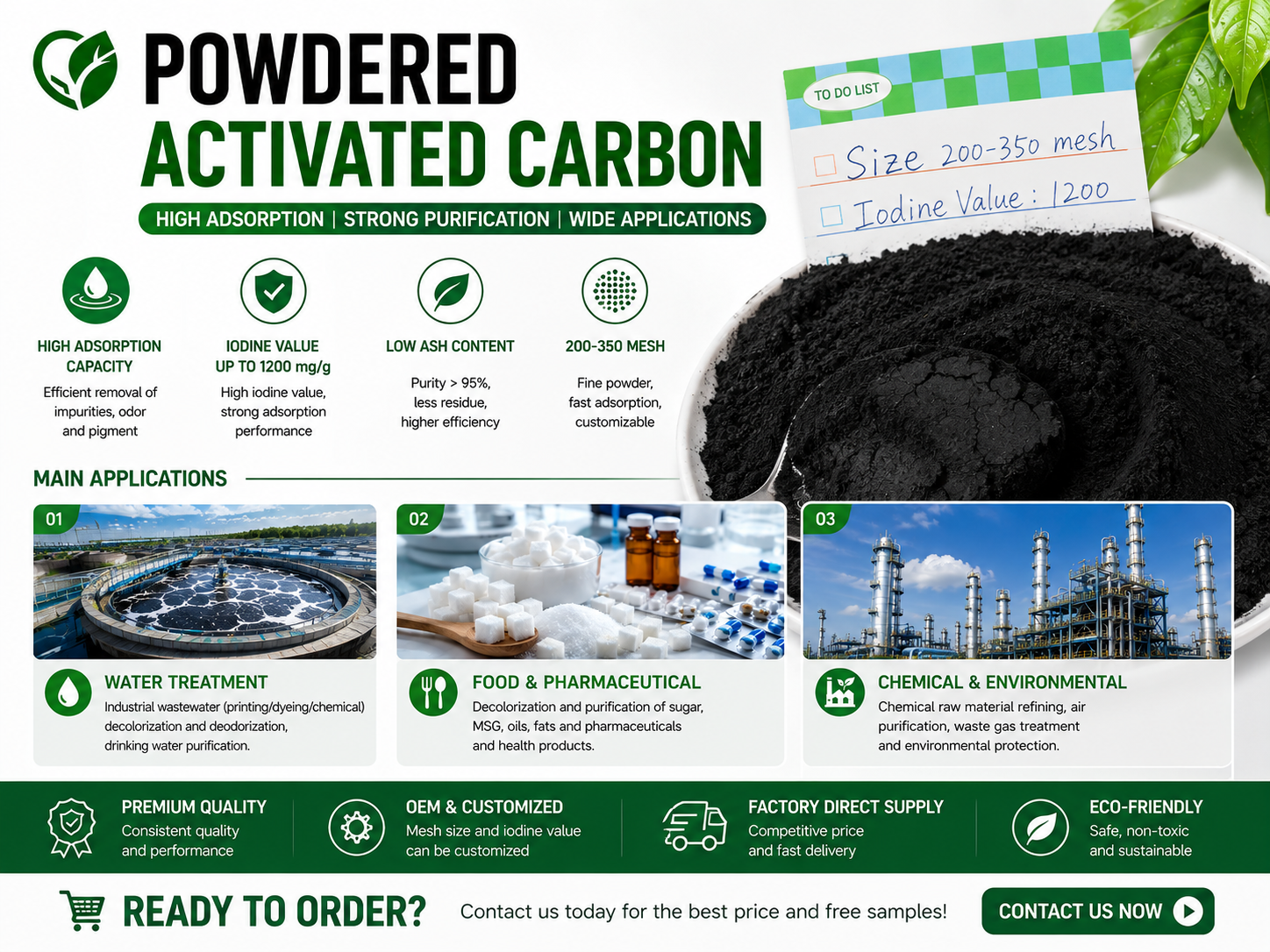
GAC is a porous adsorption medium manufactured from materials such as coal, wood, peat, and coconut shells. Its internal pore structure provides the surface area used to adsorb dissolved contaminants.
This guide explains the preliminary calculation methods for both GAC and PAC systems and shows how dosage affects replacement cost and operating performance.
Why Activated Carbon Dosage Calculation Matters
Activated carbon must provide enough adsorption capacity and contact time to meet the required effluent concentration.
An undersized system may experience premature breakthrough, meaning the contaminant begins appearing in the treated water earlier than expected. An oversized system may still work, but it increases the initial carbon inventory, vessel size, handling requirements, and replacement cost.
The calculation also affects:
Carbon vessel dimensions
Media purchasing quantities
PAC storage and feeding equipment
Treatment cost per cubic meter
Carbon replacement schedules
Spent carbon handling
System redundancy
Lead-lag vessel configuration
For GAC systems, carbon life and carbon usage rate are influenced by EBCT, influent contaminant concentration, the selected breakthrough criterion, and seasonal water-quality variation.
An initial calculation is therefore useful for budgeting and equipment selection. Final design values should be verified using laboratory adsorption tests, rapid small-scale column tests, pilot studies, supplier performance data, or operating data from comparable systems. EPA and ITRC guidance identifies RSSCT and pilot testing as methods for estimating contact time, treated bed volumes, carbon usage, and replacement intervals under site-specific conditions.
What Information Is Needed for an Activated Carbon Dosage Calculation?
Before calculating the amount of carbon, collect the following information.
Water flow rate
Use the design flow rather than relying only on the annual average flow.
Relevant flow values may include:
Average daily flow
Maximum daily flow
Peak hourly flow
Minimum operating flow
Number of operating hours per day
For continuous PAC dosing, the dose must follow the actual flow rate. For GAC, peak flow affects the hydraulic loading rate and the EBCT available inside each vessel.
Influent and target concentrations
Record:
Influent contaminant concentration
Required effluent concentration
Allowable breakthrough concentration
Expected seasonal concentration range
Frequency and duration of concentration peaks
The difference between influent and target concentrations provides an initial contaminant mass-removal requirement.
Target contaminant
Activated carbon performance differs among contaminants. The required dosage may change substantially between:
Taste and odor compounds
Natural organic matter
Pesticides
Volatile organic compounds
Cyanotoxins
Color-causing compounds
Industrial organic pollutants
PFAS compounds
Carbon selection should therefore be based on the target compound and water matrix rather than a general carbon specification alone.
Activated carbon properties
Useful product data include:
Activated carbon type
Raw material
Particle size
Apparent or bulk density
Surface area
Pore-size distribution
Hardness
Moisture
Ash content
Target-specific adsorption data
Bulk density is needed to convert a calculated GAC bed volume into a carbon weight.
Water-quality conditions
Adsorption may be affected by:
Dissolved organic carbon
Natural organic matter
pH
Temperature
Suspended solids
Oil and grease
Competing organic compounds
Pre-oxidation chemicals
Biological activity
Natural organic matter can compete with target contaminants for adsorption sites. For PAC treatment of cyanotoxins, EPA notes that the required dose varies with the toxin, carbon type, and natural organic matter background.
Treatment and operating criteria
The calculation should also define:
Required removal percentage
Selected EBCT
Allowable pressure drop
Vessel arrangement
Backwashing requirements
Replacement criterion
Safety allowance
Whether spent carbon will be disposed of or reactivated
What Factors Affect Activated Carbon Dosage?
The amount calculated from flow alone is only a hydraulic estimate. Actual activated carbon consumption is also governed by adsorption performance.
Contaminant concentration and loading
A higher influent concentration creates a greater contaminant mass load. If all other conditions remain unchanged, the carbon will generally reach its replacement criterion sooner.
Required effluent concentration
A stricter treatment target can cause the carbon to be replaced before its total theoretical capacity has been used. The working capacity at the selected breakthrough concentration is therefore more useful than a maximum equilibrium capacity.
Contact time
Adsorption takes time. A short contact time may prevent contaminants from diffusing sufficiently into the carbon pores.
For fixed-bed systems, contact time is represented by empty bed contact time. EPA defines EBCT as the empty carbon-bed volume divided by the volumetric flow rate.
Competing compounds
Water rarely contains only one adsorbable compound. Natural organic matter and other dissolved organics can occupy adsorption sites and reduce the usable capacity for the target contaminant.
Research presented through an EPA drinking-water workshop found that increasing total organic carbon had a strong adverse effect on GAC use rates in the PFAS application being studied.
Carbon pore structure
Two activated carbons with similar iodine numbers may perform differently for a particular contaminant because adsorption also depends on pore-size distribution, surface chemistry, particle size, and the properties of the target molecule.
An iodine number should therefore remain a product quality indicator. It should not be converted directly into a site-specific working adsorption capacity without target-contaminant testing.
Temperature and pH
Temperature and pH may change contaminant solubility, ionization, carbon surface charge, and adsorption equilibrium. These effects are compound-specific and should be evaluated using representative water.
How to Calculate GAC Dosage Using EBCT
GAC dosage calculation normally begins with the required carbon-bed volume.
The main design parameter is empty bed contact time.
EBCT formula
Where:
= empty bed contact time
= effective GAC bed volume
= volumetric flow rate
Rearranging the formula:
The flow and time units must correspond. When flow is expressed in cubic meters per minute and EBCT is expressed in minutes, the calculated bed volume is in cubic meters.
Converting GAC bed volume to carbon weight
After determining bed volume, calculate the required carbon mass:
Where:
= activated carbon mass
= GAC bed volume
= bulk density of the selected GAC
Use the supplier’s actual bulk-density data. Do not substitute true material density, skeletal density, or particle density.
Worked GAC dosage calculation
Consider a water treatment plant with the following preliminary design conditions:
Design flow: 500 m³/h
Selected EBCT: 10 minutes
GAC bulk density: 480 kg/m³
Convert the flow to cubic meters per minute:
Calculate the GAC bed volume:
Calculate the GAC mass:
The preliminary carbon requirement is approximately:
or:
This result represents the total effective carbon volume required to provide a 10-minute EBCT at the stated flow.
It does not yet determine:
Vessel diameter
Bed depth
Number of vessels
Hydraulic loading rate
Freeboard
Backwash expansion space
Support-media volume
Internal piping volume
Replacement interval
These items must be considered during equipment design.
Series and parallel GAC vessels
A system may use multiple vessels.
In a parallel arrangement, the total flow is divided among the operating vessels. Each vessel must provide the selected EBCT at its assigned flow.
In a series or lead-lag arrangement, water passes through two or more carbon beds sequentially. The combined beds provide the total system contact time, while the polishing vessel protects the treated-water quality after the lead vessel begins to approach breakthrough. EPA’s PFAS treatment cost documentation describes both series and parallel GAC arrangements and their relationship to design EBCT.
How to select the correct EBCT
There is no single EBCT suitable for every activated carbon application.
EPA states that the minimum EBCT varies with:
The contaminant
Required removal percentage
Type of GAC
Influent-water characteristics
Competing chemical species
The agency recommends determining the required value from site-specific conditions rather than treating one default EBCT as universally applicable.
A preliminary EBCT may be selected from previous experience, regulatory guidance, equipment standards, or supplier recommendations. Final confirmation should rely on column testing, pilot operation, or documented full-scale performance.
How to Calculate PAC Dosage for Water Treatment
PAC is normally dosed by concentration rather than installed as a permanent bed.
The two most common quantities are:
PAC dose in mg/L
PAC consumption in kg/h or kg/day
PAC dosage formula
For daily consumption:
Where:
= PAC consumption in kg/day
= PAC dose in mg/L
= water flow in m³/day
The conversion works because one mg/L applied to one cubic meter of water equals one gram.
For hourly consumption:
Where is the hourly flow in m³/h.
Worked PAC dosage calculation
Assume:
Water flow: 10,000 m³/day
Preliminary PAC dose: 15 mg/L
Calculate daily PAC consumption:
For 30 days of operation:
The plant would require approximately 4.5 metric tons of PAC for a 30-day period, assuming constant flow and a constant 15 mg/L dose.
How to determine the PAC dose in mg/L
The formula converts an established dose into a daily mass requirement. It does not determine which dose will achieve the treatment target.
The starting PAC dose should be evaluated using:
Jar testing
Adsorption testing
Supplier application data
Historical plant performance
Pilot trials
Process-control monitoring
EPA water-treatment guidance recommends using jar testing and related treatment evaluation to establish an effective PAC dose, followed by process monitoring during operation.
For cyanotoxin treatment, EPA also notes that the dose depends on carbon type, pore structure, toxin type, and natural organic matter. This illustrates why a dose from one plant should not be copied directly to another plant without verification.
How to Calculate Activated Carbon Usage Rate and Replacement Frequency
Initial fill quantity and long-term carbon consumption are separate calculations.
A GAC vessel may contain a large initial carbon inventory, while its annual carbon cost depends on the rate at which the media reaches the selected breakthrough criterion.
Step 1: Calculate contaminant mass removed
For a simplified single-contaminant estimate:
Where:
= contaminant mass removed in kg/day
= water flow in m³/day
= influent concentration in mg/L
= target effluent concentration in mg/L
Step 2: Estimate carbon usage rate
Where:
= carbon usage rate in kg carbon/day
= contaminant mass removed in kg/day
= working adsorption capacity in kg contaminant/kg carbon
The working capacity should correspond to the actual water matrix and the selected breakthrough limit.
Maximum equilibrium capacity from an ideal laboratory isotherm may overestimate full-scale performance because a real fixed bed experiences mass-transfer limitations, competing adsorption, hydraulic variation, and an operating breakthrough limit.
Step 3: Estimate replacement interval
Where:
= estimated service life in days
= installed GAC mass in kg
= estimated carbon usage rate in kg/day
Simplified replacement example
Assume:
Flow: 5,000 m³/day
Influent concentration: 2.2 mg/L
Target concentration: 0.2 mg/L
Working capacity: 0.08 kg contaminant/kg carbon
Installed GAC: 20,000 kg
Contaminant removal load:
Carbon usage rate:
Estimated service life:
This preliminary estimate suggests a service life of approximately 160 days.
The example is a simplified mass balance. A multi-contaminant water matrix cannot always be represented by adding isolated single-compound capacities. Column tests and breakthrough monitoring provide a stronger basis for replacement planning.
Replacement based on treated bed volumes
GAC life is also expressed as the number of bed volumes treated before breakthrough:
Where:
= treated bed volumes
= cumulative treated-water volume
= effective GAC bed volume
Once a site-specific breakthrough value has been established, the expected operating period can be estimated from the daily number of bed volumes processed.
RSSCT and pilot testing are commonly used to estimate how many bed volumes a selected medium can treat before replacement or regeneration.
How Activated Carbon Dosage Changes by Application
The same calculation framework can be used across multiple water-treatment applications, but the design assumptions must be adjusted.
Drinking water treatment
GAC and PAC may be used for:
Taste and odor control
Synthetic organic chemicals
Pesticides
Natural organic matter
Disinfection by-product precursors
Cyanotoxins
Emerging contaminants
PAC is useful where temporary or seasonal dosing is required. GAC is better suited to continuous fixed-bed treatment and longer-term polishing.
Wastewater treatment
Industrial and municipal wastewater may contain high concentrations of dissolved organic matter and multiple competing contaminants.
A simple single-solute adsorption capacity may be unsuitable for these systems. Representative wastewater testing is particularly important when COD, color, solvents, surfactants, or other organic compounds compete for carbon capacity.
Groundwater treatment
Groundwater systems often use fixed-bed GAC vessels because the flow is relatively stable and the carbon can be operated in lead-lag arrangements.
The calculation should include:
Peak pumping rate
Seasonal contaminant concentration
Iron and suspended solids
Pretreatment requirements
Individual-well operating schedules
Breakthrough monitoring locations
PFAS treatment
GAC has been implemented at full scale for PFAS removal, although performance varies across PFAS compounds and water matrices. Shorter-chain PFAS generally present greater treatment challenges for conventional GAC than many longer-chain compounds.
PFAS sizing should consider:
Individual PFAS compounds
Influent PFAS concentrations
Dissolved organic carbon
Selected GAC product
EBCT
Lead-lag operation
Breakthrough criteria
Spent media management
Reactivation or disposal route
ITRC recommends RSSCT or pilot testing to determine appropriate contact time and expected treated bed volumes for the media and water being evaluated.
Common Activated Carbon Dosage Calculation Mistakes
Treating GAC and PAC as the same calculation
PAC dosage is normally expressed in mg/L and converted into kg/day.
GAC sizing is based on bed volume, EBCT, bulk density, breakthrough performance, and carbon usage rate.
Combining these methods can produce results that are dimensionally incorrect.
Using inconsistent units
Common unit errors include:
Using m³/h with an EBCT stated in minutes
Mixing pounds and kilograms
Mixing gallons and cubic meters
Using mg/L without the correct mass conversion
Using true density instead of bulk density
A unit-conversion line should be shown in every worked calculation.
Selecting EBCT without considering the contaminant
An EBCT used for taste-and-odor control may not provide the required performance for another contaminant.
The selected value should reflect the contaminant, water quality, carbon type, and removal objective.
Using theoretical capacity as working capacity
Theoretical or equilibrium capacity does not automatically represent the usable full-scale capacity at the selected breakthrough limit.
Working capacity should account for:
Competition
Contact time
Mass-transfer zone
Water chemistry
Breakthrough criterion
Hydraulic conditions
Calculating from iodine number alone
Iodine number is useful for comparing certain characteristics of activated carbon. It is not a direct dosage formula for every target contaminant.
Target-specific adsorption or column data provide a stronger basis for system design.
Ignoring natural organic matter
Natural organic matter can consume carbon capacity even when it is not the primary regulated target. This may shorten GAC life or increase the required PAC dose.
Using the vessel’s total volume as carbon-bed volume
The internal vessel volume may include:
Freeboard
Underdrain
Support media
Backwash expansion space
Internal piping
Unfilled headspace
Only the effective activated carbon bed volume should be used in the EBCT calculation.
Applying a fixed replacement date without monitoring breakthrough
A calendar-based replacement interval can be useful for maintenance planning, but it should be supported by influent, intermediate, and effluent monitoring.
Lead-lag systems can use the lead-vessel effluent as an early indication that carbon movement or replacement is approaching.
How to Optimize Activated Carbon Dosage and Operating Cost
Use target-specific carbon selection
The lowest-priced carbon per kilogram may produce a higher annual cost if its working capacity is lower or its replacement frequency is higher.
Compare carbons using:
Treated bed volumes
Carbon usage rate
Cost per unit of water
Cost per unit of contaminant removed
Reactivation yield
Disposal requirements
Optimize PAC through jar testing
PAC feed rates can be adjusted against changing raw-water quality instead of maintaining the maximum dose throughout the year.
A practical dosing plan may include:
Baseline dose
Seasonal dose
High-event dose
Maximum equipment capacity
Monitoring trigger for dose adjustment
Use lead-lag GAC operation
A lead-lag arrangement can improve media utilization by allowing the first vessel to absorb most of the contaminant load while the second vessel protects the final effluent.
After the lead bed reaches its replacement criterion, the polishing vessel can be moved into the lead position and a fresh bed installed downstream. EPA describes this operating approach in its GAC treatment documentation.
Improve pretreatment
Removal of suspended solids, oil, oxidants, or excessive natural organic matter before the GAC stage may reduce fouling and competition.
Pretreatment should be assessed against its additional capital and operating cost.
Monitor carbon performance
Useful monitoring indicators include:
Target contaminant concentration
Total organic carbon
UV absorbance
Taste and odor
Color
Pressure drop
Flow distribution
Effluent from individual vessels
Cumulative treated bed volumes
Include the full replacement cost
Annual activated carbon cost may include:
A carbon with a higher purchase price may still provide a lower total treatment cost when it offers longer service life or higher reactivation recovery.
Frequently Asked Questions
How much activated carbon do I need?
For GAC, calculate bed volume from flow and EBCT, then multiply the bed volume by bulk density.
For PAC, multiply the selected dose in mg/L by the water flow in m³/day and divide by 1,000 to obtain kg/day.
The result remains a preliminary estimate until the adsorption performance has been confirmed with representative water.
What is the difference between GAC dosage and PAC dosage?
GAC dosage refers mainly to fixed-bed volume and installed carbon mass.
PAC dosage refers to the concentration of powdered carbon added to water, commonly expressed in mg/L.
How do I convert activated carbon volume to weight?
Use:
Use the bulk density from the carbon supplier’s current product data sheet.
What is a typical EBCT for GAC?
A universal value is unavailable because the required EBCT changes with the contaminant, removal target, carbon product, competing compounds, and water chemistry.
Published case studies may provide an initial reference, while site-specific column or pilot testing should support final selection. EPA and ITRC both emphasize the relationship between EBCT, media performance, and site conditions.
How often should GAC be replaced?
Replacement should occur before the final treated-water concentration exceeds the project’s breakthrough criterion.
The interval can be estimated from:
Working carbon capacity
Carbon usage rate
Treated bed volumes
Pilot-test results
Historical breakthrough data
Routine water-quality monitoring
Does a higher iodine number mean that less carbon is required?
A higher iodine number does not automatically establish a lower dosage for a specific contaminant.
Dosage should be based on target-specific performance, working adsorption capacity, contact time, and the actual water matrix.
What is a fixed-bed activated carbon system?
A fixed-bed system holds GAC inside a vessel while water passes through the media.
The main preliminary sizing parameters are flow, EBCT, bed volume, bed depth, bulk density, and expected treated bed volumes before breakthrough.
Does PFAS require a different GAC calculation?
The basic EBCT and bed-volume formulas remain the same. PFAS projects require additional attention to the PFAS mixture, dissolved organic carbon, breakthrough of individual compounds, lead-lag operation, and spent-carbon management. RSSCT or pilot testing is strongly relevant to estimating media life.
Is carbon source dosage the same as activated carbon dosage?
Carbon source dosing normally refers to adding substances such as methanol, acetate, or another biodegradable carbon source to support biological denitrification.
Activated carbon dosage refers to the amount of GAC or PAC used as an adsorbent. The two calculations address different treatment processes.
Can laboratory adsorption capacity be used directly for full-scale sizing?
Laboratory data can support preliminary comparison and design.
Full-scale working capacity may be lower because of competing compounds, mass-transfer limitations, hydraulic conditions, and the selected breakthrough concentration. Column testing or pilot operation provides a more reliable basis for estimating service life.
Conclusion
Activated carbon dosage calculation should separate three related design questions:
How much GAC is required to provide the selected EBCT?
How much PAC must be dosed per hour or per day?
How quickly will the carbon be consumed and replaced?
For GAC:
For PAC:
These equations provide the hydraulic and mass basis for preliminary sizing. The final dosage should account for contaminant-specific adsorption, water chemistry, working capacity, breakthrough criteria, and representative treatment testing.
推荐阅读
Activated Carbon Dosage Calculation: How to Size GAC and PAC for Water Treatment
2026-08-06
2025-06-01
2026-07-24
2026-07-08


